
14. MPCA failed to protect people against health impacts of trash incineration
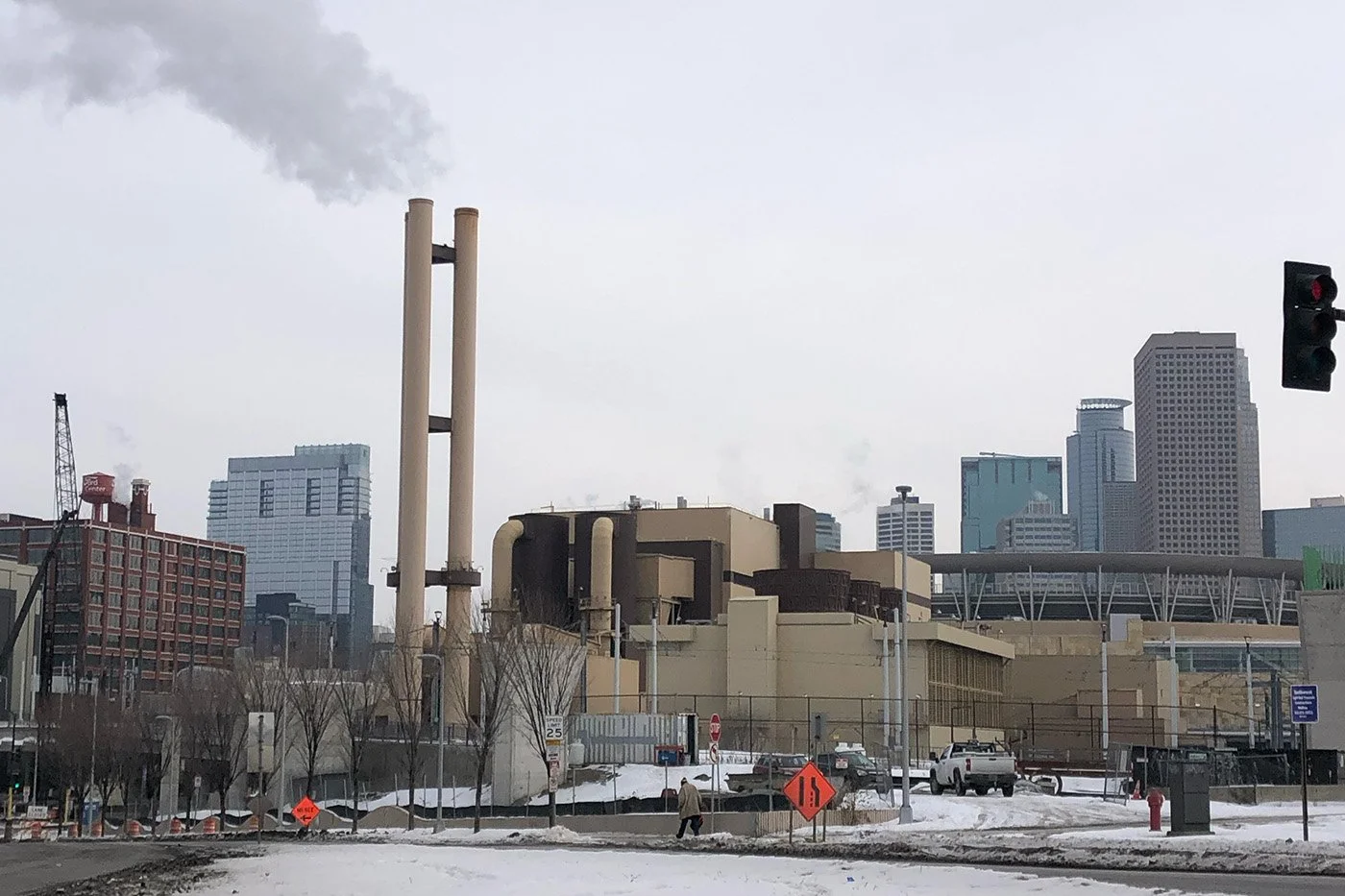
Hennepin Energy Recovery Center (HERC) trash burner in Minneapolis. Photo courtesy of MN EJ Table.
The Minnesota Pollution Control Agency (MPCA) allowed the Hennepin Energy Recovery Center (HERC) to be built in 1989 by a majority-Black, segregated, redlined community already overburdened by pollution. Regulators knew they were concentrating even more harm and pollution in a sacrifice community. Now, children in ZIP code 55411 — the North Minneapolis neighborhood closest to HERC — go to the emergency room for asthma at the highest rate in Minnesota. Using EPA's own COBRA tool, independent scientists estimate that just HERC's particulate emissions cause 1 to 2 premature deaths and tens of millions of dollars in health damages every year. The Minnesota Pollution Control Agency is the state agency responsible for limiting that harm. For 35 years, it has instead provided the regulatory framework that allows it to continue. And now, as a major effort is underway to finally transition away from HERC through the work of the Zero Burn Coalition and elected allies, MPCA continues to protect HERC in multiple ways. HERC was a key reason why Minnesota Environmental Justice Table helped lead the passage of a cumulative impacts law in 2023 to force MPCA to stop concentrating pollution in sacrifice communities.
Permits designed around the facility, not the community
MPCA's air permit set emission limits based on what pollution control technology could capture in 1995 — not on what is safe to breathe. That distinction is not technical. A permit built around operational capacity rather than public health is a permit that protects the facility.
That original failure has since been compounded. The Biden EPA proposed updated 2024 emission standards,13 years after it was required to do so according to the Clean Air Act. HERC would fail to meet these standards for pollutants, including hydrochloric acid and nitrogen oxides. Even those standards did not implement requirements of the Clean Air Act based on actual risks from emissions rather than on pollution control equipment. Instead of proactively updating permit standards based on newer science over this unacceptably long time, MPCA did nothing. Science has moved on and shown the HERC air pollutants pose greater risks than known in 1995. The “zombie permit” has not changed to reflect this.
Monitoring that isn't monitoring
HERC tests for dioxins once a year, under controlled conditions. Research shows actual dioxin emissions from incinerators under some conditions run hundreds of times higher than annual stack tests indicate. MPCA accepts the annual snapshot as compliance. PFAS has recently been shown to be emitted from Minnesota incinerators, including HERC. But risk data is still limited, with safety limits for only a few of the many detected PFAS. There has been no monitoring in the past, despite knowledge of likely risks for several decades, and PFAS are not included in permits. The risks limits have been falling dramatically for the few well-studied PFAS, but we are still far from a final understanding of their risks. This raises questions about why MPCA is not acting in a more proactive way to protect the public and the environment. Dangerously slow or passive responses to public harm have been a hallmark of MPCA. Emissions during startups, shutdowns, and malfunctions — when pollution spikes — fall outside required monitoring entirely.
These failures in monitoring and permit conditions are why the Zero Burn Coalition has proposed a HERC Accountability Bill.
Risk assessments that erase the most exposed
Independent scientists found that HERC's health risks are several times higher for residents closest to the facility — the same environmental justice communities MPCA is mandated to protect. MPCA's risk assessments don't account for the greater susceptibility of EJ residents, exclude several major HERC pollutants, and are based on data and analysis that independent scientists say consistently underestimate harm.
The policy framework that gives Hennepin County cover
Hennepin County has repeatedly fearmongered about landfills, despite the fact that every incinerator closure in the country required landfills as a bridge solution. MPCA has provided the backing for the county’s propaganda at almost every turn.
“Landfills or Incinerators” is a classic false dichotomy fallacy that MPCA reinforces. It is not a choice: incinerators send toxic ash to landfills. Moreover, incinerators actively undermine recycling and composting by requiring a guaranteed stream of burnable material. The Zero Waste expert consensus is that incinerators are an unacceptable form of waste management and block the path to Zero Waste. When the county couldn’t expand HERC in 2014, it turned to composting overnight.
Independent analysis by MCEA found that evidence of HERC harming people is stronger than evidence of landfills harming people and that regional landfill capacity exists until 2054 even if HERC closes immediately.
The agency's waste hierarchy elevates incineration above landfilling – a framework independent experts describe as outdated and no longer defensible. The waste hierarchy, in fact, is not binding; it is a general statement of preference with no legislative mandate.
The through-line: MPCA allowed HERC to be built in an overburdened Environmental Justice community in 1989. It has the tools to stop HERC from killing and disabling people. MPCA sets the permits, conducts the risk assessments, controls the waste hierarchy, and holds the landfill capacity data. At every point where it could have intervened to protect the communities most harmed by HERC, it has instead maintained the conditions that keep HERC burning. That is not a failure of capacity. It is a pattern of deliberate choices.
Sources:
Asthma Rates: Núñez, Y. et al. (2023). Cumulative burden analysis for zip codes 55407 and 55411. PSE Healthy Energy, Oakland CA.
EPA modeling — 1-2 deaths, health damages: https://www.sierraclub.org/sites/default/files/2023-08/PSE%20HERC%20Fact%20Sheet.pdf
1989 permit limits / EPA 2024 proposed standards: https://www.federalregister.gov/documents/2024/01/23/2024-00747/standards-of-performance-for-new-stationary-sources-and-emission-guidelines-for-existing-sources
MPCA risk assessments underestimate harm: https://hercshutdown.org/resources/report_HC_underestimates_HERC_risks.pdf
MPCA waste hierarchy — landfill as least preferred: https://www.pca.state.mn.us/business-with-us/landfills
Landfill capacity until 2054: https://www.mncenter.org/sites/default/files/pdfs/2025-03-19_MCEA_Updated%20Landfill%20Capacity%20(2).pdf